
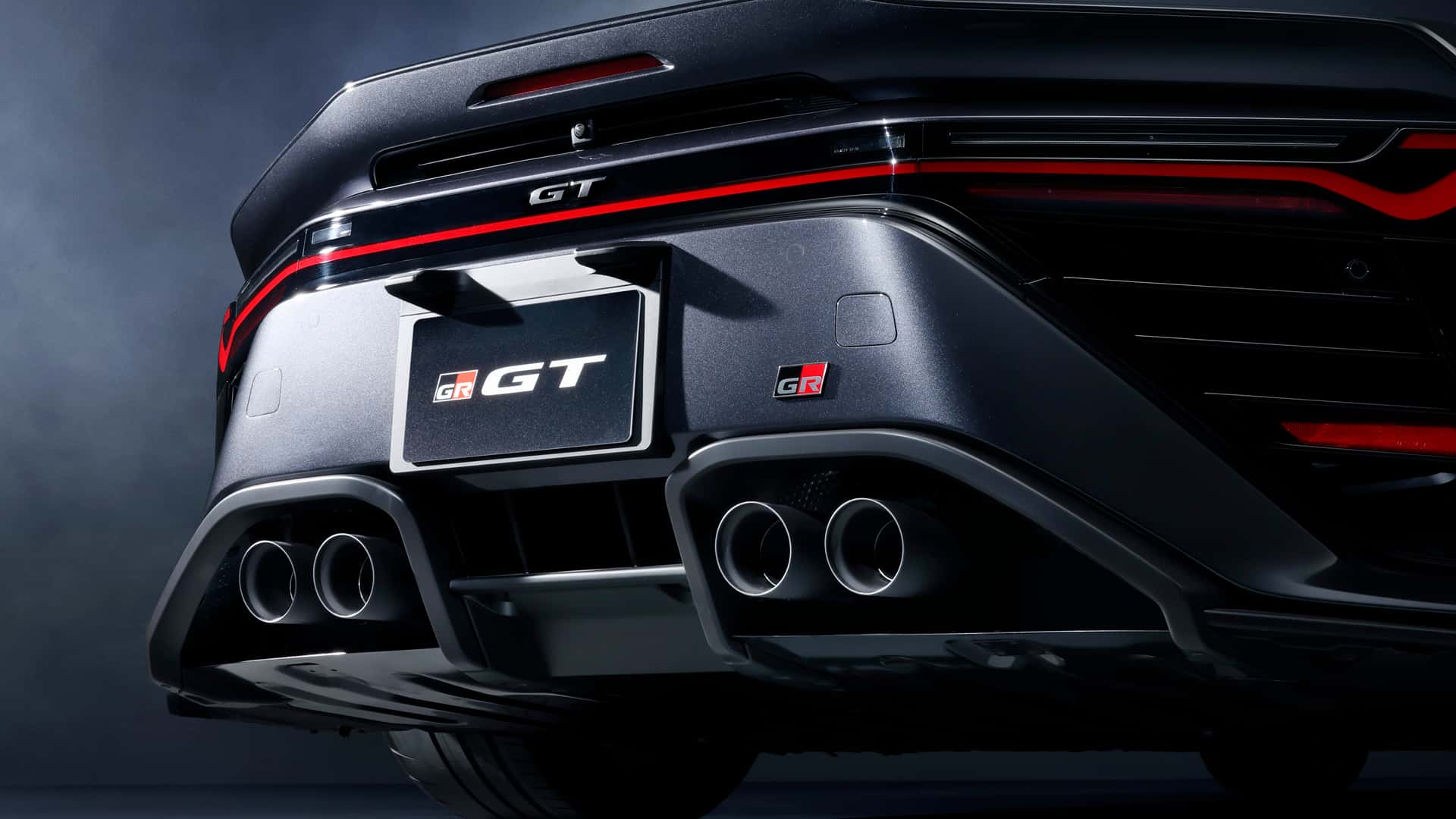
- The new Toyota GR GT might not be limited to a single version.
- Japanese media reports that a targa version is in the works.
- A hardcore version is allegedly in development as well.
- Toyota is expected to cap production at around 500 units.
Developing a business case for a supercar is tough because it takes a lot of math to convince the higher-ups and accountants that it’s a project worth pursuing. The GR GT is a highly bespoke product that has practically nothing in common with an existing Toyota product, so the engineering team had to start from scratch. However, significant economies of scale have been achieved since the flagship performance version is more or less a homologation special of the GR GT3 race car.
Even so, the R&D costs must’ve been through the roof, requiring a massive investment from a company that typically plays it safe with its product planning. After all, the last Supra was joined at the hip with the BMW Z4, while the GR86 is a collaborative effort with Subaru. As with every respectable supercar, production numbers for the GR GT are bound to be low. How low? Japan’s Magazine X (via Car Sensor) reports that only around 500 units will be made, making the GR GT as rare as the LFA.
Only Toyota knows whether the small production run will be enough to recover the investment. Since we mentioned the LFA, let’s not forget that Lexus seriously struggled to sell the V10 machine, of which it also built 500 examples. Hopefully, for its parent company’s sake, the new mid-engine beast will do better, but that will greatly depend on pricing.

Photo by: Toyota
It’s Likely To Cost Over $200,000
When Lexus’ only supercar launched in the United States back in 2010, it had a starting price of $375,000, plus $70,000 for the optional Nürburgring Package. Toyota has yet to release pricing details for the GR GT, but it’s been hinting that it’ll be a $200,000+ car. We don’t think it’ll be as expensive as the LFA, which, by the way, is returning this decade for a second generation as a fully electric supercar.
Circling back to the Magazine X report, the GR GT is unlikely to be a single model. The outlet mentions a “tuned version” is on the way, which makes us think it has something to do with a more aggressive prototype recently spotted testing at the Nordschleife. Whether it’s some Track Package or a full-blown GRMN, that’s anyone’s guess.
GR GT Targa Could Happen
That’s not all. Toyota is allegedly planning a third GR GT road-going flavor with a targa setup that might bring back the Aero Top name. It’s unclear whether it would have a manually removable roof panel or one that electrically retracts. Given the coupe’s design, there doesn’t seem to be enough room to accommodate a roof-folding mechanism, unless Toyota plans to rework the rear end heavily. However, that would add even more cost.
We’d wager a targa would have a panel that detaches from the body, keeping the rear intact, just like in the old days of the Supra Aero Top. Presumably, there would be a dedicated area to store the roof in case of sudden rain. Coming in 2027, Audi’s new electric sports car, previewed by the promising Concept C, will also have a targa setup, but with a roof that fully retracts into the rear, a first for the company.
We’re in for a long wait since the standard GR GT won’t be launched until “around 2027,” according to Toyota. Spicier derivatives could arrive later in the life cycle and likely command a surcharge over the standard coupe.
32
Source: Toyota
Motor1’s Take: While a $200,000+ Toyota seems like a tough sell, the GR GT is not your ordinary Camry or RAV4. With a twin-turbo 4.0-liter V8, an exotic shape, and a direct motorsport connection, it has all the ingredients to become a hit among deep-pocketed enthusiasts.
Adding a hardcore version and an open-top model would further increase its chances of success, but the GRMN and Aero Top are not official until Toyota says so. Either way, the regular coupe can’t come soon enough, especially since we were promised a full-blown hypercar with the GR Super Sport concept a few years ago, but that sadly never came to fruition.
Source:
Magazine X via Car Sensor