
- Luce is the name of Ferrari’s first EV.
- It has quad motors producing over 986 horsepower.
- The 122-kWh battery is rated at 329 miles of WLTP range.
- It’s likely to be a GT-type car with rear doors.
Ferrari is mere hours away from making history. May 25 marks the debut of Maranello’s first electric car, a model first announced several years ago. Although the Prancing Horse has been dripping out details over the past few months, we had to wait until today to see the EV in its full production form. The debut will take place in the coming hours at a special event in Rome.
Dubbed “Luce” (Italian for “light” or “illumination”), the inaugural EV will become Ferrari’s second model with rear doors, after the Purosangue. But while the latter takes the form of an SUV powered by a naturally aspirated V12, the upcoming model will be more of a low-slung grand tourer with four in-house-developed electric motors.
In the buildup to today’s highly anticipated reveal, Ferrari has already shared several key technical specifications. Expect a combined output of more than 986 horsepower, with four motors drawing power from a battery pack with a gross capacity of 122 kWh. Luce will need just two and a half seconds to hit 62 mph (100 km/h) from a standstill before topping out at 192 mph (310 km/h).

Ferrari Luce: Range And Weight
Ferrari’s first EV will cover 329 miles (530 kilometers) on a single charge in the WLTP cycle, although we expect a sub-300-mile rating in the EPA’s more realistic test. Owners won’t spend much time charging the battery, since the Luce can charge at up to 350 kW. Predictably, it will also be the heaviest car the company has ever built, weighing an estimated 5,070 pounds (2,300 kilograms) with a 47:53 weight distribution between the two axles.
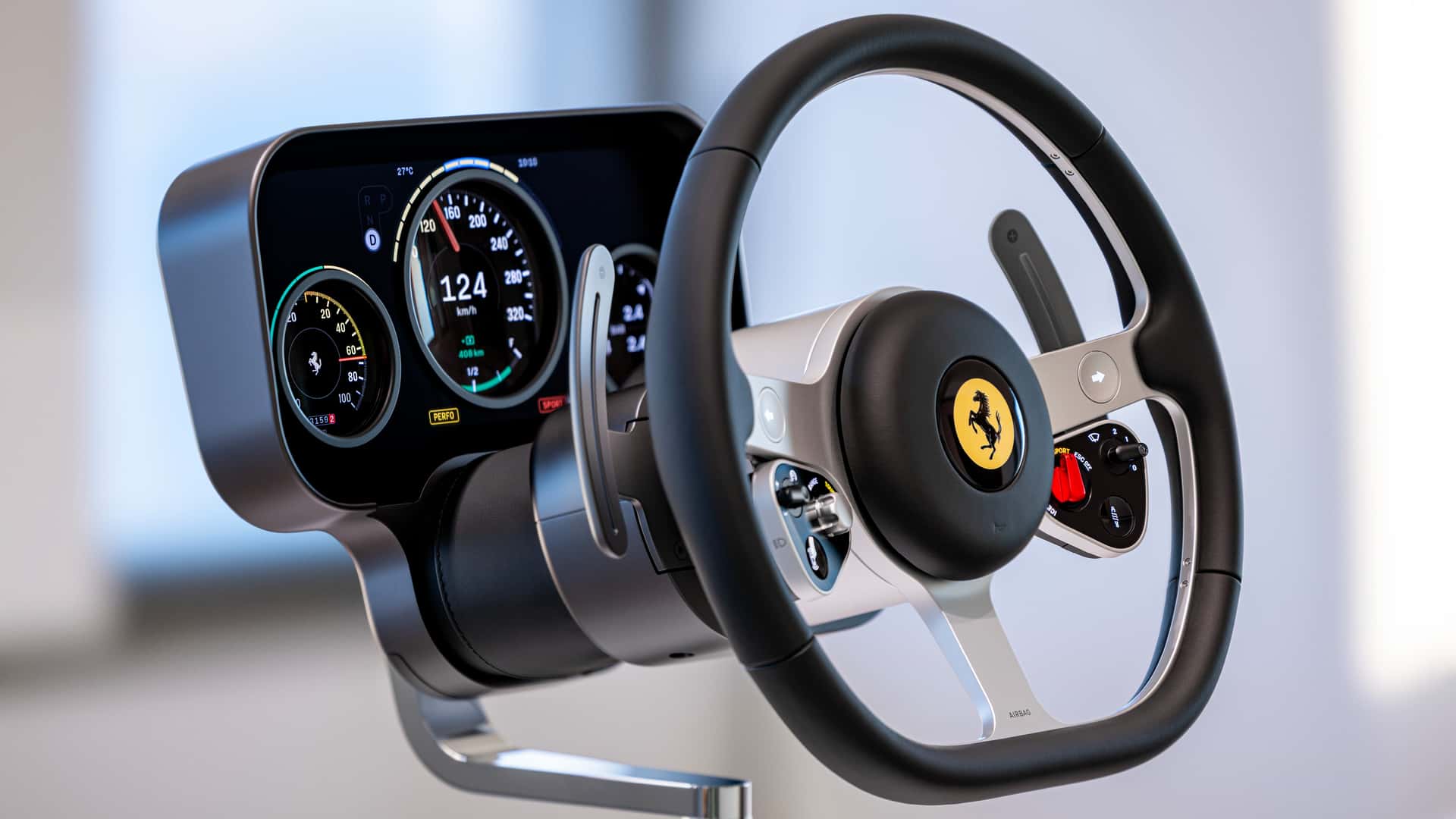
While the exterior remains a complete mystery, Ferrari has divulged some interior secrets. Luce is shaping up to be a fascinating blend of analog and digital, following a collaboration with LoveFrom. The creative collective founded by Sir Jony Ive, Apple’s former design chief, helped the Italians develop entirely new switchgear harking back to the golden era of physical controls.

Photos by: Ferrari
Apple-esque Interior
But in 2026, screens are unavoidable. Luce will feature a digital instrument cluster mounted to the steering column alongside a driver-oriented touchscreen, plus a rear display that allows passengers to adjust climate settings. Much like in the front, rear occupants will also get a few hard switches instead of relying exclusively on the touchscreen mounted to the back of the center console.
There’s still a lot we don’t know about the Luce. Pricing, for example, remains a mystery until the very last minute. Bloomberg recently alleged it will start at around €550,000, roughly 10 percent more than an earlier Reuters report suggested. It’s reasonable to assume that insiders are referring to the asking price in Italy, where value-added tax (VAT) is 22 percent. As is almost always the case, Ferrari’s first EV will likely be more affordable in the United States.
Photos by: Ferrari
Whatever it costs, Ferrari has already said it won’t force buyers interested in its low-volume special cars to purchase the EV to secure a spot on the shortlist. Luce will be assembled at a new dedicated factory within the Maranello complex responsible for EV production.
But Luce won’t represent the beginning of the end for combustion engines. By the end of the decade, Ferrari projects that 40 percent of its models will still use pure combustion powertrains, while another 40 percent will be hybrids. EVs are expected to account for the remaining 20 percent. In other words, the V6, V8, and even the V12 are sticking around, albeit in varying degrees.
The livestream starts at 4:10 PM Eastern Time (10:10 PM CEST).
23
Source: Ferrari
Motor1’s Take: Traditionalists and enthusiasts may dismiss the idea of an electric Ferrari, but in the real world, Luce is a necessity. Even the exotic Italian brand must comply with increasingly strict emissions regulations, and plug-in hybrids alone are no longer enough to reduce CO2 emissions.
From another perspective, developing EVs allows Ferrari to continue selling combustion-powered cars. The ultra-rich who want to buy a rare V12 likely wouldn’t be able to do so for much longer without hybrids and fully electric models helping reduce the lineup’s overall carbon footprint.
At the same time, the idea of an electric Ferrari is undeniably intriguing. A company that built its heritage on decades of roaring combustion engines is now mere hours away from unveiling its first EV. However, Luce won’t be completely silent, as Ferrari promises “authentic” sounds baked into the experience. For a more engaging drive, there will also be five selectable power levels, although the company has ruled out simulated gear changes.